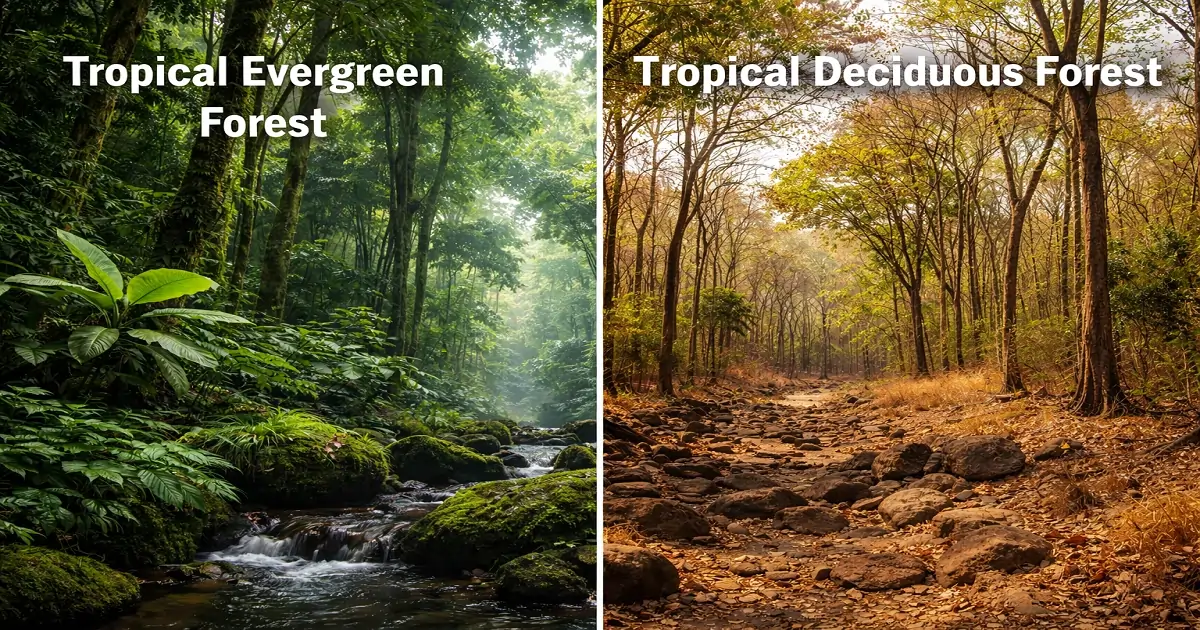
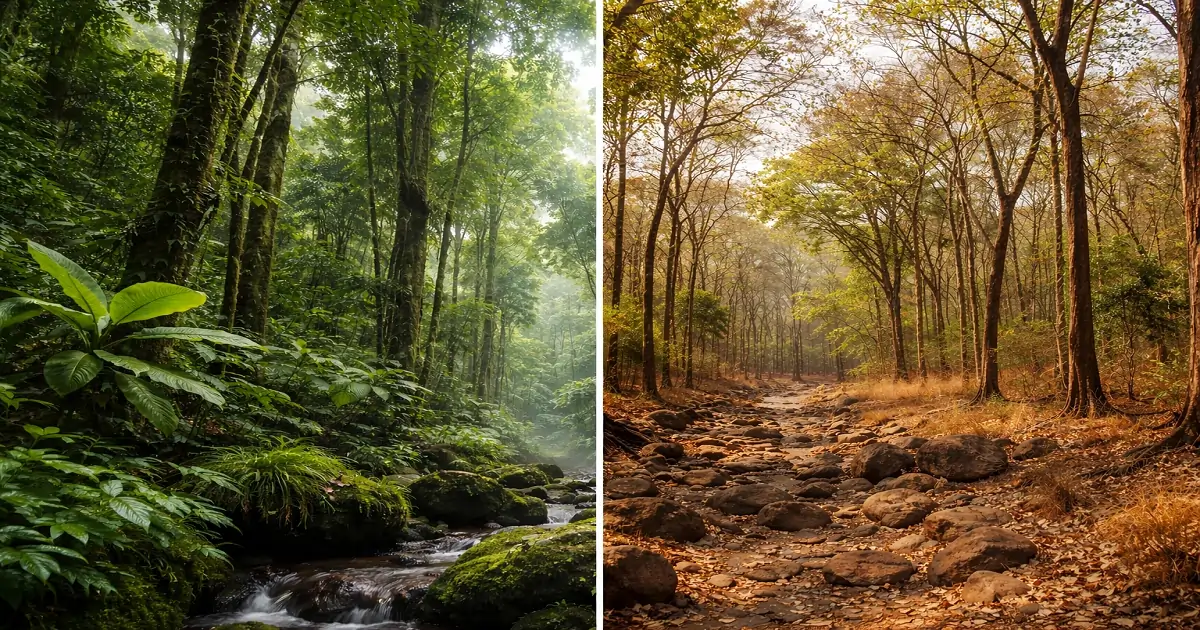
The difference between tropical evergreen and deciduous forests lies mainly in how trees respond to climate and seasons. Tropical evergreen forests remain green throughout the year, while tropical deciduous forests shed their leaves during dry periods.
They are often confused because both occur in warm regions and support rich wildlife. However, their growth patterns and seasonal behavior are quite different. Understanding these differences matters because each forest type plays a unique ecological role.
It also helps in conservation planning and climate studies. Within the wider discussion of forest types, these two forests clearly show how rainfall and seasons shape ecosystems.
What Are Tropical Evergreen Forests?
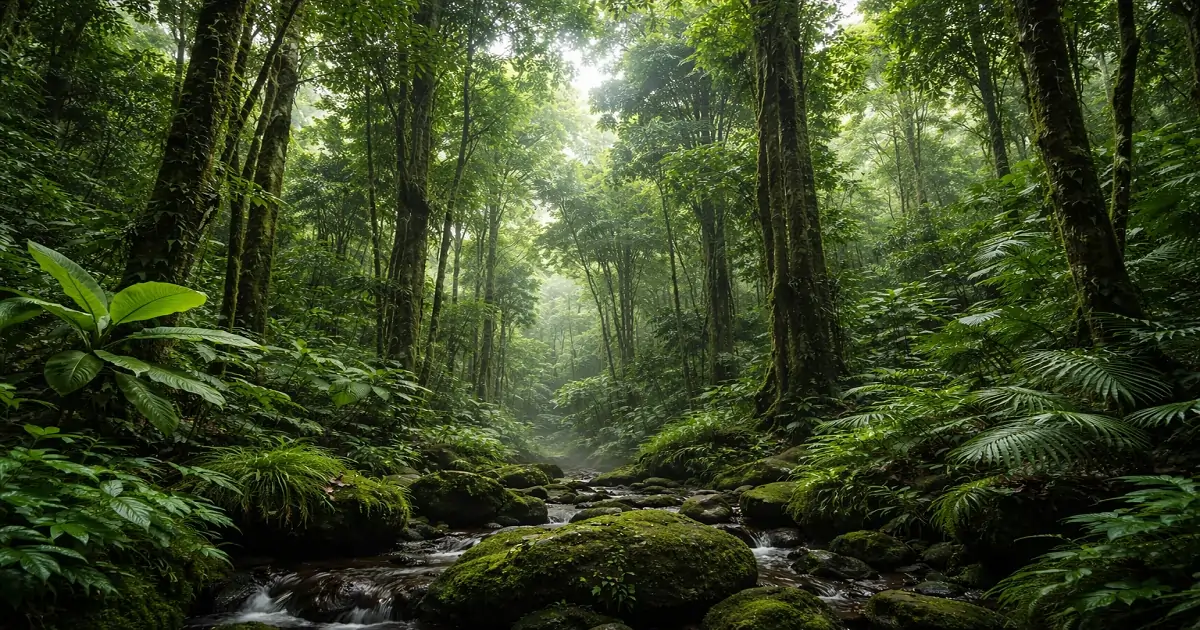
Tropical evergreen forests are dense forests found in regions with warm temperatures and heavy rainfall throughout the year. Trees in these forests do not shed all their leaves at once. Instead, old leaves fall gradually while new ones grow continuously.
Because water and sunlight remain available, plant growth never fully stops. Therefore, these forests stay green in every season. They form complex ecosystems with tall trees, thick undergrowth, and multiple vegetation layers.
Tropical evergreen forests are often called rainforests. They are among the most productive and biologically rich ecosystems on Earth. Their stable conditions support long-term ecological balance.
Key Characteristics of Tropical Evergreen Forests
Trees in tropical evergreen forests retain their leaves all year. Leaf fall happens slowly and continuously.
The canopy is very dense and has multiple layers. Tall trees form the upper layer, while shrubs grow below.
Photosynthesis continues throughout the year. This is possible because sunlight, warmth, and moisture remain constant.
Climate and Rainfall Conditions
These forests receive very high rainfall, usually more than 2000 millimetres annually. Rain falls in most months.
Humidity remains high throughout the year. As a result, the air stays moist and warm.
There is no clear dry season. Therefore, plants do not face long water shortages.
Distribution and Major Regions
Tropical evergreen forests are mainly found near the equator. These regions receive consistent sunlight and rainfall. Major regions include the Amazon Basin, the Congo Basin, and Southeast Asia.
In India, they occur in the Western Ghats and parts of the Northeast. In contrast, forest distribution changes significantly with altitude and temperature.
Coniferous Forest in India: Distribution & Importance explains how cooler climates and higher elevations support needle-leaved forests, highlighting how climate and geography shape different forest types across the country.
For a deeper understanding of dense, year-round green ecosystems in these regions, A Guide to the Tropical Rainforest of India explores the structure, biodiversity, and ecological role of tropical evergreen forests in detail.
Flora and Fauna Diversity
Vegetation includes tall broadleaf trees, climbers, and epiphytes like orchids and mosses. Ferns grow near the forest floor.
Animal life is highly diverse. Examples include monkeys, sloths, hornbills, frogs, insects, and butterflies.
Because food and shelter are available year-round, wildlife habitats remain stable and continuous.
What Are Tropical Deciduous Forests?
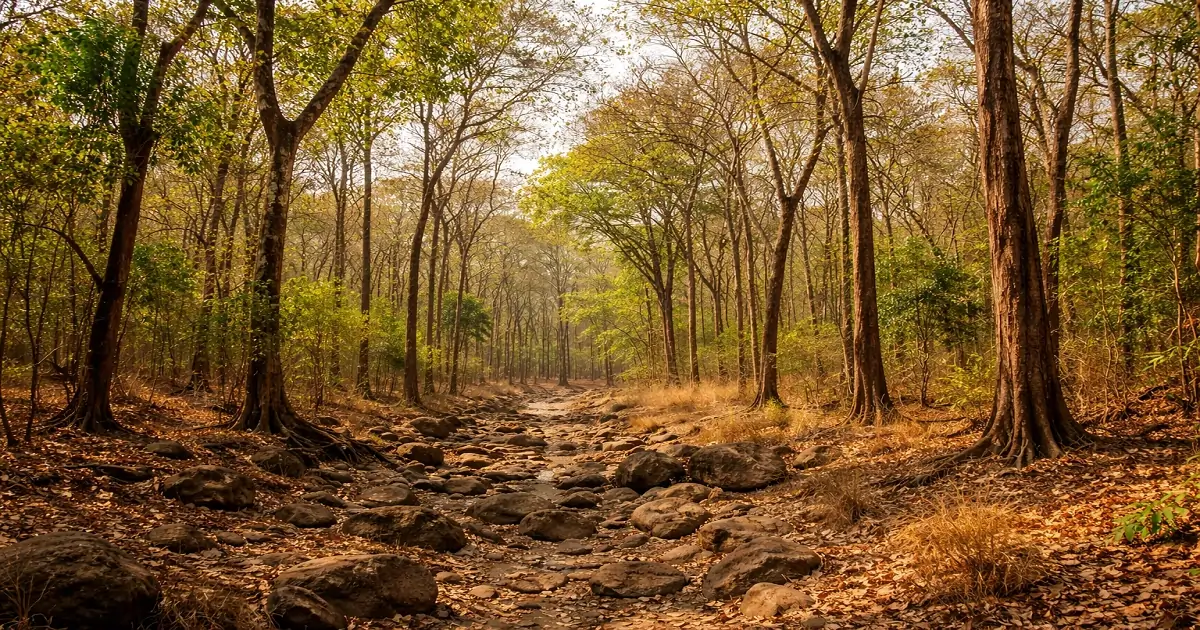
A deciduous forest is a forest type where trees lose their leaves during a specific season each year. These forests commonly occur in temperate regions with moderate rainfall, usually between 800 and 1400 millimeters annually.
They are well adapted to climate extremes, tolerating cold winters that can reach around −20°C and warm summers rising into the low 30°C range.
Leaf shedding helps trees reduce water loss when rainfall decreases. Therefore, it acts as an important survival strategy.
These forests appear green and dense during the wet season. However, they look dry and open during the dry season. This seasonal change defines their character.
Key Characteristics of Tropical Deciduous Forests
Trees shed their leaves during dry months. This reduces water loss through evaporation.
Vegetation density changes with seasons. Growth increases rapidly after the rains begin.
Leaf fall helps conserve water and protects trees from drought stress.
For a more detailed explanation of how these traits vary by region and climate, Characteristics and Distribution of Tropical Deciduous Forests provides an in-depth look at their structure, ecological adaptations, and geographic spread.
Climate and Seasonal Patterns
Rainfall in these forests is moderate, usually between 1000 and 2000 millimetres annually.
There are distinct wet and dry seasons. Each season strongly affects plant growth.
Temperatures may vary slightly. Dry seasons are often hotter than wet seasons.
Distribution in India and the World
In India, tropical deciduous forests cover large areas. They are common in central and northern regions.
Major states include Madhya Pradesh, Chhattisgarh, Odisha, Jharkhand, Maharashtra, and Uttar Pradesh.
Globally, these forests occur across Asia, Africa, and parts of South America.
Flora and Fauna Adaptations
Common tree species include teak, sal, and oak in suitable regions. These trees tolerate dry conditions.
Food availability follows seasonal cycles. Fruiting and flowering peak during wet months.
Animals adapt by migrating, storing food, or changing feeding habits. Deer, elephants, and birds show such adaptations.
Difference Between Tropical Evergreen and Deciduous Forests
The difference between tropical evergreen and deciduous forests becomes clear when their structure, climate response, and seasonal behavior are compared. Although both develop in warm regions, they respond differently to rainfall patterns.
Tropical evergreen forests remain green throughout the year, while tropical deciduous forests shed leaves during dry seasons. This contrast affects biodiversity levels, soil quality, and overall ecosystem stability. The comparison below summarizes these key differences clearly.
| Comparison Aspect | Tropical Evergreen Forests | Tropical Deciduous Forests |
| Leaf retention | Trees retain leaves throughout the year | Trees shed leaves during the dry season |
| Climate conditions | Consistently warm and humid climate | Warm climate with distinct dry periods |
| Rainfall pattern | Very high rainfall, usually above 2000 mm, evenly spread | Moderate rainfall concentrated in wet months |
| Biodiversity level | Extremely high species richness with stable populations | Moderate to high diversity with seasonal variation |
| Soil characteristics | Soils often nutrient-poor due to heavy leaching | Soils relatively fertile because of leaf litter buildup |
| Seasonal changes | Little to no visible seasonal change | Clear seasonal changes in forest appearance |
These differences matter ecologically because they determine how plants and animals survive in each forest type. Evergreen forests provide stable conditions and continuous resources.
In contrast, deciduous forests support life through seasonal adaptation and resource cycling.
Climate is the primary force driving these forest behaviors. Consistent rainfall allows evergreen forests to grow continuously, whereas seasonal rainfall pushes deciduous trees to conserve water.
Therefore, climate directly shapes forest structure, function, and long-term resilience.
Explore More: Overview of Forest and Wildlife Resources
Importance of Tropical Evergreen and Deciduous Forests
Tropical evergreen and deciduous forests are vital for maintaining ecological balance. Although different in structure, both contribute essential ecosystem services. Their combined role supports life on Earth.
These forests regulate climate, support biodiversity, and protect natural resources. Understanding their importance helps connect forest studies with broader environmental learning.
Ecological Importance
Both forest types provide habitat stability for plants and animals. Evergreen forests offer year-round shelter.
Tree roots bind soil and prevent erosion. Leaf litter improves soil structure and fertility.
Forests regulate the water cycle by controlling runoff and supporting groundwater recharge.
Role in the Global Carbon Cycle
Evergreen forests absorb carbon continuously due to year-round photosynthesis. This creates steady carbon storage.
Deciduous forests absorb carbon mainly during the growing season. Absorption slows during leaf shedding.
Together, they regulate atmospheric carbon and help reduce climate change impacts.
Importance for Biodiversity
Evergreen forests support exceptional species richness under stable conditions.
Deciduous forests maintain complex food webs that change with seasons.
Both forests enhance ecosystem resilience and biodiversity, reinforcing concepts discussed in comprehensive studies of forest types and their role in sustaining life.
Importance of Tropical Evergreen and Deciduous Forests
Tropical evergreen and deciduous forests are vital for maintaining natural balance. Although they differ in structure and climate response, both support life in essential ways.
These forests regulate climate, protect land, and sustain ecosystems. Therefore, understanding their importance helps connect forest studies with wider environmental learning.
Ecological Importance
Both forest types provide habitat stability for plants and animals. Evergreen forests offer year-round shelter and food.
Tree roots bind soil and reduce erosion. Fallen leaves improve soil structure and fertility.
Forests also regulate the water cycle. They control runoff, support groundwater recharge, and reduce floods.
Role in the Global Carbon Cycle
Evergreen forests absorb carbon continuously because photosynthesis occurs throughout the year. This ensures steady carbon storage.
Deciduous forests absorb carbon mainly during the growing season. Absorption slows when leaves fall.
Together, both forests regulate atmospheric carbon and help moderate global climate patterns.
Importance for Biodiversity
Evergreen forests support high species richness due to stable conditions. Many species depend on constant resources.
Deciduous forests maintain dynamic food webs that change with seasons. This supports diverse life forms.
Both forest types strengthen ecosystem resilience, a key idea explained in broader discussions on forest types and their role in sustaining life.
Human Impact on Evergreen and Deciduous Forests
Human activities increasingly affect tropical forests. Development pressures have altered natural forest systems.
Population growth, resource demand, and land conversion continue to threaten both forest types worldwide.
Deforestation and Habitat Loss
Logging removes valuable timber from both forests. Evergreen forests recover slowly after clearing.
Agriculture expands more rapidly into deciduous forests because land becomes open during dry seasons.
Urban expansion fragments habitats. Wildlife movement becomes restricted, especially in evergreen regions.
Conservation and Sustainable Management Practices
Protected areas help conserve remaining forest cover. Legal safeguards limit uncontrolled exploitation.
Reforestation restores degraded land using native species. This improves long-term forest recovery.
Sustainable forestry balances resource use with protection. Community involvement ensures lasting conservation success.
Conclusion
Tropical evergreen and deciduous forests differ in leaf behavior, climate response, and seasonal patterns. These differences shape how each ecosystem functions.
Both forest types matter equally. They support climate regulation, biodiversity, and human well-being.
Protecting them requires awareness and responsible management. Learning more about forest types encourages informed choices and stronger conservation efforts.