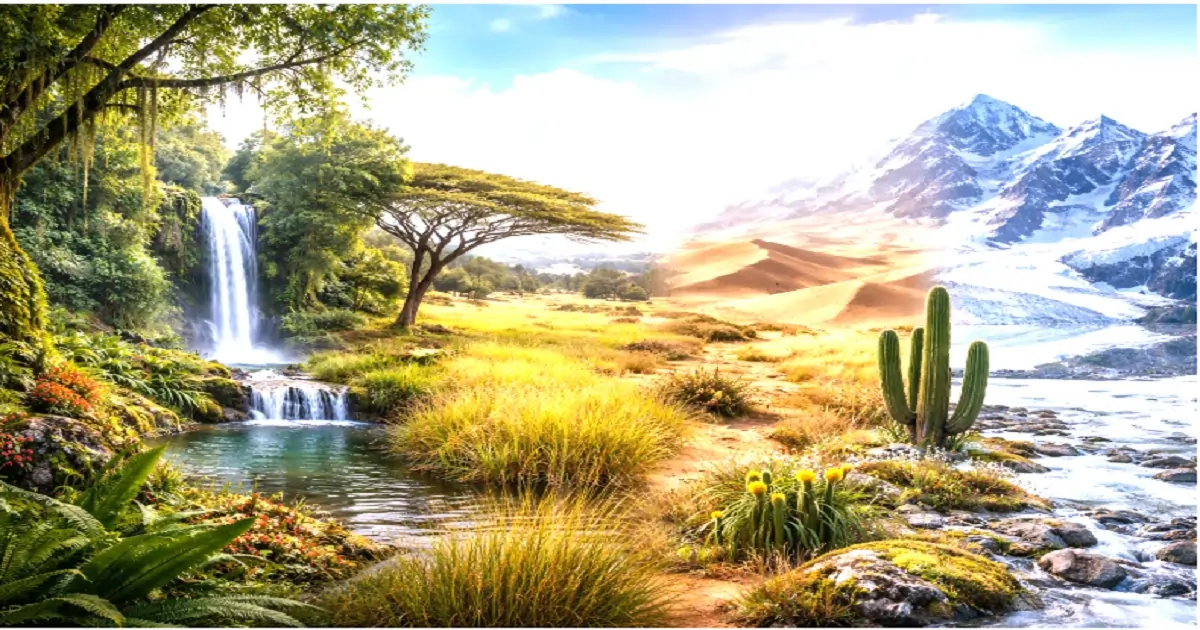
Natural vegetation refers to plant life that grows on its own, without direct human control. It develops naturally based on climate, soil, and land conditions. Therefore, it reflects how nature shapes plant growth in different regions.
You can see this in forests, grasslands, deserts, and mountain areas. Each type forms under specific conditions and supports a unique environment. For example, dense forests grow in high rainfall areas, while sparse plants survive in dry regions.
Natural vegetation is not just about plants. It plays a key role in maintaining balance in the environment. It supports wildlife, protects soil, and helps regulate climate. Because of this, understanding its types, distribution, importance, and conservation becomes essential in today’s changing world.
What is Natural Vegetation?
Natural vegetation forms the base of plant life found across different regions. It helps explain how plants grow naturally without human involvement. Understanding this concept is important because it connects climate, land, and ecosystems in a simple way.
Meaning and Definition
Natural vegetation includes plants that grow on their own without human support. These plants develop naturally based on climate, soil, and land features. Therefore, they reflect the true condition of a region’s environment.
In simple terms, it includes trees, shrubs, grasses, and other plants that grow without planting or care. For example, forests in rainy regions and grasses in dry areas are forms of natural vegetation. Each type forms according to the surrounding conditions.
It also helps answer common questions like what is vegetation and which is called vegetation. Vegetation means the plant life found in a particular area. Natural vegetation is the original plant cover that grows without human interference.
This makes it an important part of geography and environmental studies. It helps us understand how nature functions in different regions.
Difference Between Natural and Cultivated Vegetation
Natural vegetation grows without human involvement, while cultivated vegetation depends on human care. Farmers plant crops, water them, and protect them from pests. However, natural vegetation grows freely in forests, grasslands, and deserts.
For example, wheat and rice fields are cultivated vegetation. On the other hand, forest trees and wild grasses are natural vegetation. This difference helps explain how human activity changes plant growth patterns.
Other Terms Used for Vegetation
Natural vegetation is also known by other simple terms. It is often called natural plant cover because it covers the land naturally. Another common term is plant community, which refers to groups of plants growing together.
These terms help describe vegetation in a broader way. They are often used in geography and environmental studies.
Factors Affecting Natural Vegetation
Natural vegetation does not grow the same everywhere. Several natural and human factors influence how plants grow in different regions. These factors determine the type, density, and distribution of vegetation across the world.
Climate (Temperature and Rainfall)
Climate is the most important factor affecting natural vegetation. Temperature and rainfall directly influence plant growth. Therefore, different climates support different types of vegetation.
In areas with heavy rainfall, dense forests grow easily. For example, tropical regions have thick forests due to constant rain. However, areas with low rainfall develop sparse vegetation like grasses or shrubs.
Temperature also plays a key role, as warm regions support rich plant life while cold regions have limited vegetation. For instance, tundra regions have only mosses and small plants because of low temperatures.
Together, rainfall and temperature decide the type, density, and distribution of vegetation. This is why vegetation changes from one region to another.
Soil Characteristics
Soil affects how plants grow and survive. Fertile soil supports healthy vegetation, while poor soil limits plant growth. Therefore, soil quality plays an important role.
Moisture in the soil also matters. Plants need water to grow, so soils that hold moisture support better vegetation. Sandy soils, however, lose water quickly and support fewer plants.
Different plants require different soil types. For example, some trees grow well in deep, rich soil, while grasses can survive in less fertile soil.
Relief and Topography
Relief and land features influence natural vegetation. Altitude, slope, and land shape affect plant growth. Therefore, vegetation changes with height and terrain.
In mountainous areas, vegetation changes with altitude. Lower regions may have forests, while higher areas may have grasses or no vegetation at all. This pattern is common in hilly regions.
Slope also affects water flow and soil depth. Steep slopes often have less vegetation because soil gets washed away. Flat areas, however, support more plant growth.
Human Influence
Human activities also affect natural vegetation. Cutting forests, farming, and urban growth change plant cover. Therefore, natural vegetation often gets replaced by cultivated land.
For example, forests may be cleared for agriculture or buildings. This reduces natural plant cover and affects the environment. Over time, such changes can alter entire ecosystems.
Types of Natural Vegetation
Natural vegetation appears in many forms across the world. Each type develops under specific climate and land conditions. Therefore, understanding these types helps explain how plant life adapts to different environments.
These types are usually grouped based on rainfall, temperature, and location. As a result, similar environments often support similar vegetation. This makes classification easier and more meaningful.
Major Global Types of Natural Vegetation
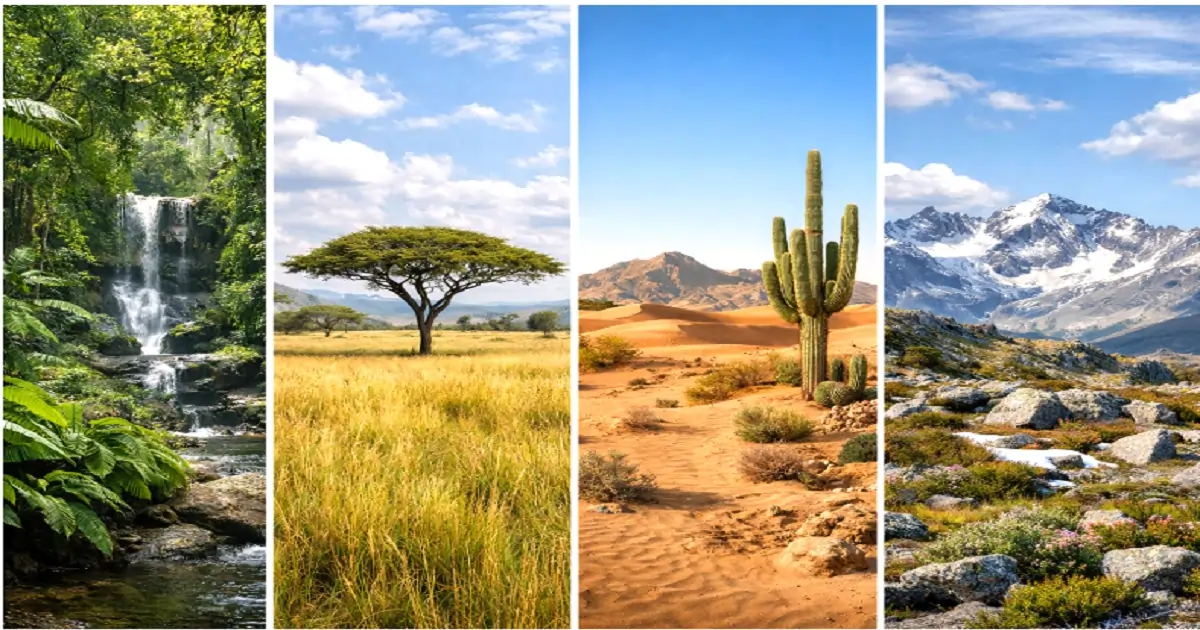
Natural vegetation is broadly divided into major types found across different regions. These include forests, grasslands, deserts, tundra, and mountain vegetation. Each type reflects a unique combination of climate and soil conditions.
For example, dense forests grow in areas with heavy rainfall. On the other hand, grasslands and deserts develop in regions with limited water. As a result, these broad groupings are part of the major types of natural vegetation and are often described as major vegetation regions and biomes, shaped by climate and land conditions.
Forest Vegetation
Forest vegetation includes areas covered with dense trees and thick plant growth. These regions usually receive high rainfall and have warm temperatures. As a result, forests support a wide range of plant and animal life.
Different types of forests exist based on climate conditions. For example, tropical forests grow in hot and wet regions, while temperate forests develop in moderate climates. Therefore, forest vegetation shows great diversity across the world.
Within forest vegetation, different climatic conditions give rise to specific formations such as dry deciduous forests. These forests shed leaves during dry seasons to conserve water.
Grassland Vegetation
Grasslands are regions where grasses dominate instead of trees. These areas usually receive moderate rainfall, which is not enough to support dense forests. Therefore, grasses grow widely, while trees remain scattered.
Grasslands are important for grazing animals and agriculture. For example, many farming regions depend on grassland soil for crop production. Besides this, these areas support wildlife such as deer and antelope.
They are commonly found in regions like prairies, steppes, and savannas. Each type varies slightly based on climate and location.
Desert Vegetation
Desert vegetation grows in areas with very low rainfall. Plants in these regions adapt to dry conditions and limited water. Therefore, they often have deep roots or thick leaves to store water.
Common desert plants include cacti and shrubs. These plants grow slowly and remain widely spaced. However, they play an important role in preventing soil erosion.
Desert vegetation shows how plants survive in extreme environments. It also highlights the importance of adaptation in nature.
Tundra Vegetation
Tundra vegetation is found in very cold regions near the poles. These areas have low temperatures and frozen soil for most of the year. Therefore, only small plants like mosses and lichens can grow.
The growing season is very short, which limits plant development. However, these plants still support wildlife such as reindeer and Arctic foxes.
Tundra vegetation shows how life can exist even in harsh climates. It is simple in structure but important for the ecosystem.
Mountain Vegetation
Mountain vegetation changes with altitude. As height increases, temperature decreases, which affects plant growth. Therefore, different types of vegetation appear at different levels.
Lower slopes may have forests, while higher areas may have grasses or shrubs. At very high altitudes, vegetation becomes sparse due to cold conditions.
This variation becomes more distinct in high-altitude regions, particularly in vegetation zones of mountainous regions. These regions clearly show how altitude influences plant life.
Natural Vegetation in India
India has a wide variety of natural vegetation due to its diverse climate and landforms. From tropical regions to mountainous areas, different conditions support different plant types. Therefore, vegetation patterns in India are highly varied.
Rainfall, temperature, and soil play a key role in shaping these patterns. As a result, different regions show distinct vegetation types.
Overview of Vegetation in India
India’s vegetation reflects its geographical diversity. Regions with heavy rainfall support dense forests, while dry areas have sparse vegetation. Therefore, plant life changes from one region to another.
These patterns are further organized into major vegetation categories across India. This classification helps in understanding vegetation distribution more clearly.
The Five Main Types of Natural Vegetation in India
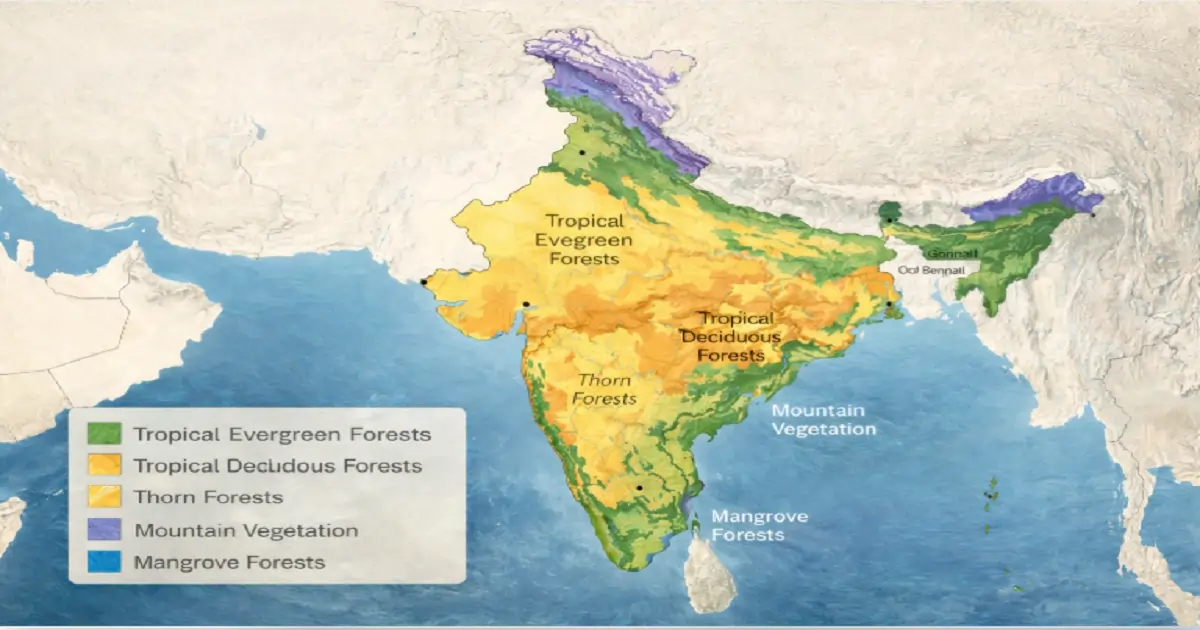
India’s natural vegetation is commonly divided into five main types, each shaped by climate and environmental conditions.
Tropical evergreen forests grow in regions with heavy rainfall and remain green throughout the year, forming dense and layered plant cover.
Tropical deciduous forests occur in areas with moderate rainfall and shed their leaves during dry seasons. A common example is found in monsoon-based forest regions.
Thorn forests develop in dry re gions with low rainfall, where vegetation consists mainly of shrubs and small trees adapted to reduce water loss.
Mountain vegetation is found in hilly and mountainous areas, where plant types change gradually with altitude.
Mangrove forests grow in coastal regions with saline water and play an important role in protecting shorelines while supporting marine ecosystems, as seen in the largest mangrove forest in India.
Regional Distribution Patterns
Natural vegetation in India varies from region to region. Northern areas have mountain vegetation, while southern regions have tropical forests. Therefore, climate and landforms strongly influence plant distribution.
Rainfall patterns also affect vegetation. Areas with high rainfall have dense forests, while dry regions have sparse plant cover.
Regional variation is especially visible in northern areas such as vegetation patterns in Jammu and Kashmir. These patterns clearly show how altitude and climate shape vegetation.
Distribution of Natural Vegetation Across the World
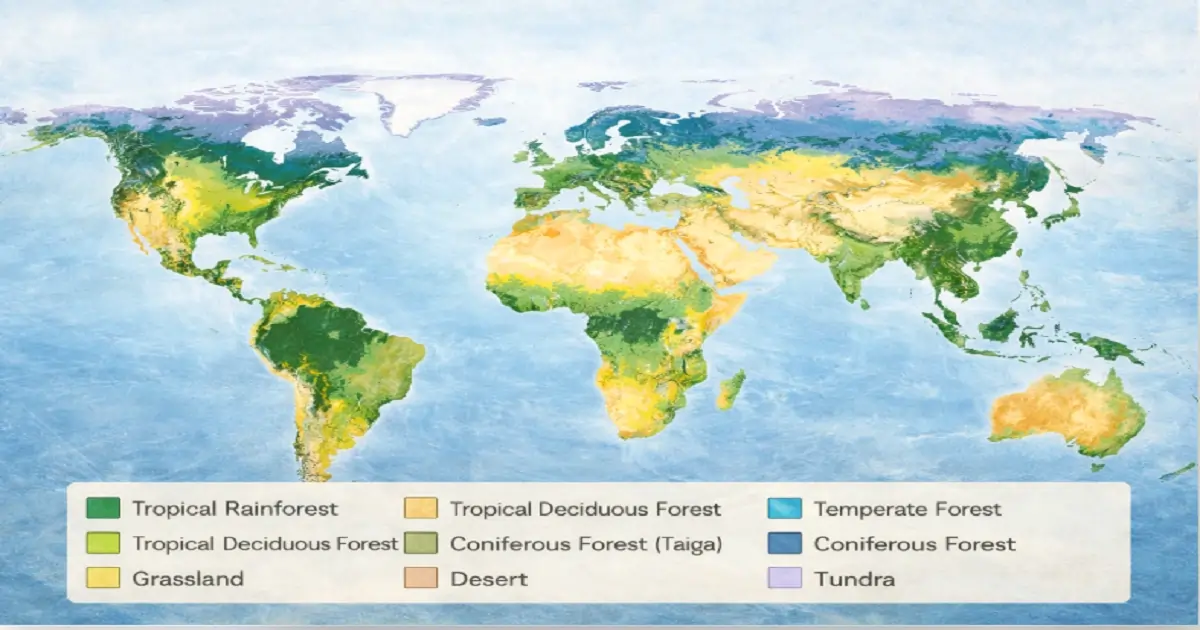
Natural vegetation is not evenly spread across the Earth. It changes from one region to another based on climate and location. Therefore, understanding its distribution helps explain global environmental patterns.
Different regions support different types of vegetation. These patterns follow clear natural rules linked to temperature, rainfall, and land conditions.
Latitudinal Patterns
Natural vegetation often follows latitudinal patterns across the globe. As we move from the equator to the poles, climate conditions change gradually. Therefore, vegetation also changes in a predictable way.
Near the equator, high temperature and heavy rainfall support dense forests. These regions have rich biodiversity and thick plant cover. However, as we move toward tropical and subtropical areas, grasslands and deserts become more common.
Further toward the poles, temperatures drop significantly. As a result, only small plants like mosses and lichens can survive. This gradual change shows how latitude influences vegetation patterns.
Vegetation Zones and Climate Relationship
Vegetation zones are closely linked to climate conditions. Temperature and rainfall together decide which plants can grow in a region. Therefore, similar climates often have similar vegetation types.
For example, regions with high rainfall support forests, while dry regions develop deserts or grasslands. Besides this, seasonal changes also affect vegetation growth. Some plants shed leaves during dry periods to conserve water.
Climate also affects soil moisture and sunlight availability. These factors influence plant growth and survival. As a result, vegetation zones form naturally based on climate patterns.
Examples from Different Regions
Different parts of the world show clear examples of vegetation distribution. Tropical regions have dense forests, while dry regions support desert plants. Similarly, grasslands are found in areas with moderate rainfall.
In colder regions, vegetation becomes sparse and simple. For instance, colder regions are dominated by needle-leaf forest formations. These forests are adapted to low temperatures and snowfall.
Importance of Natural Vegetation
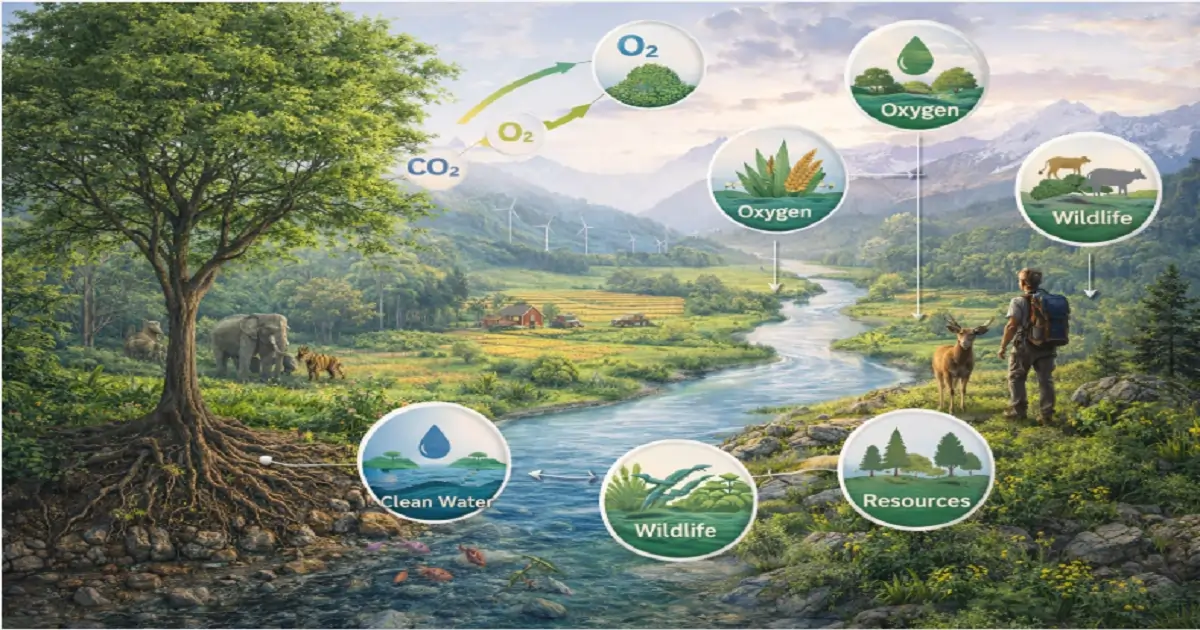
Natural vegetation plays a vital role in maintaining life on Earth. It supports ecosystems, provides resources, and helps balance the environment. Therefore, it is essential for both nature and human life.
Understanding its importance helps us see why protecting vegetation is necessary.
Ecological Importance
Natural vegetation supports ecosystems by providing habitat for wildlife. Many animals depend on plants for food and shelter. Therefore, vegetation helps maintain biodiversity.
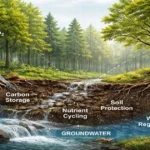
Plants also produce oxygen and absorb carbon dioxide. This process helps maintain the balance of gases in the atmosphere. Besides this, vegetation prevents soil erosion by holding soil in place.
It also supports the water cycle by helping in rainfall and groundwater recharge. As a result, natural vegetation plays a key role in maintaining natural balance.
Economic and Human Uses
Natural vegetation provides many resources for human use. People depend on plants for food, fuel, medicine, and raw materials. Therefore, vegetation has strong economic importance.
Forests provide timber and other products, while grasslands support livestock. Besides this, many medicines come from plant sources. These resources support livelihoods and industries.
However, overuse of these resources can harm natural vegetation. Therefore, careful use is necessary to maintain balance.
Role in Climate and Environmental Stability
Natural vegetation helps regulate climate by controlling temperature and moisture levels. Plants absorb carbon dioxide, which helps reduce the effects of climate change. Therefore, they play an important role in environmental stability.
Vegetation also protects land from extreme weather conditions. It reduces the impact of floods and droughts. As a result, it helps maintain environmental balance.
These functions connect closely with value and protection of plant cover.
Conservation of Natural Vegetation
Natural vegetation is under pressure due to human activities and environmental changes. Therefore, conservation has become essential to protect plant life and ecosystems.
Protecting vegetation helps maintain ecological balance and supports sustainable development.
Need for Conservation
Natural vegetation is decreasing due to increasing human activities. Forests are cleared for agriculture, industries, and urban growth. Therefore, conservation is necessary to protect plant life.
Without vegetation, soil erosion increases and climate patterns may change. This affects both nature and human life. Besides this, loss of vegetation also reduces biodiversity.
Conservation helps maintain balance and ensures resources are available for future generations.
Major Threats to Vegetation
Several factors threaten natural vegetation. Deforestation is one of the main causes. Trees are cut for farming, construction, and other uses. Therefore, plant cover is reduced over time.
Climate change also affects vegetation patterns. Changes in temperature and rainfall disturb plant growth. Besides this, overgrazing and pollution further damage vegetation.
These threats can lead to long-term environmental problems if not controlled.
Basic Conservation Approaches
Conservation of natural vegetation involves protecting and managing plant resources. Governments and organizations create protected areas like national parks and reserves. Therefore, these areas help preserve natural plant cover.
Sustainable practices, such as controlled use of resources, also support conservation. Besides this, awareness among people plays an important role in protecting vegetation.
These approaches are part of broader efforts related to protection and management of vegetation.
Relationship Between Natural Vegetation and Wildlife
Natural vegetation and wildlife are closely connected. Plants provide shelter and living space for animals. Therefore, different types of vegetation support different kinds of wildlife.
Forests, for example, offer dense cover for animals like tigers and birds. Grasslands support grazing animals such as deer and antelope. Thus, each vegetation type creates a suitable habitat.
Vegetation also forms the base of food chains. Plants are primary producers, which means they make their own food. Herbivores eat plants, and carnivores depend on herbivores. This creates a natural balance in ecosystems.
Besides this, wildlife depends on vegetation for survival. Loss of plant cover can lead to loss of animal species. Therefore, protecting vegetation also helps protect wildlife. This connection shows how closely life forms depend on each other.
Examples of Natural Vegetation
Natural vegetation appears in different forms across the world. Each type grows under specific environmental conditions. Therefore, examples help in understanding these variations more clearly.
Tropical rainforests are dense and found in high rainfall areas. Grasslands have wide open spaces covered mainly with grasses. Desert vegetation includes shrubs and plants adapted to dry conditions.
In colder regions, tundra vegetation includes mosses and small plants. Mangroves grow in coastal areas with salty water. These examples reflect broader categories of plant communities.
Natural Vegetation in Geography Studies
Natural vegetation is an important part of geography. It explains how climate, soil, and landforms influence plant life. Therefore, it helps build a clear understanding of natural environments.
The study of vegetation helps explain how different regions support different plant types. These concepts connect climate patterns with real-world landscapes. Besides this, they also build awareness about environmental protection.
Vegetation studies also connect with maps and regions. They link ideas with real examples seen across the world. As a result, they play a key role in building environmental understanding and practical knowledge.
Conclusion
Natural vegetation shows how plant life adapts to different conditions across the world. From dense forests to sparse deserts, each type reflects climate and land features. Therefore, it helps us understand natural patterns more clearly.
It also plays an important role in supporting wildlife, maintaining ecological balance, and providing essential resources. Besides this, its distribution shows how closely climate, land, and life are connected. These patterns help explain the relationship between nature and living systems.
However, increasing human activities are affecting natural vegetation in many regions. This makes conservation more important than ever. Protecting vegetation helps maintain balance, supports biodiversity, and ensures a stable environment for future generations.