Do forests really protect soil from erosion? This question matters more today than ever before. Across the world, land degradation is increasing, and healthy soil is disappearing fast. Climate change, deforestation, and poor land use have made soil erosion a serious concern.
Soil is not just dirt. It supports food systems, water cycles, and entire ecosystems. When soil erodes, farms suffer, rivers fill with sediment, and forests lose their foundation. This relationship highlights why forests and their importance extend far beyond tree cover alone.
This relationship highlights why forests and their importance extend far beyond tree cover alone. Therefore, understanding whether forests protect soil from erosion is essential for both people and nature.
Science clearly shows that forests protect soil from erosion. Through roots, canopy cover, and organic layers, forests stabilize land and reduce soil loss.
This article explains the science, facts, and evidence behind this natural protection and why it matters for the future.
What Is Soil Erosion and Why Is It a Serious Environmental Issue?
Soil erosion happens when the top layer of soil is worn away. Wind and water are the main natural forces behind this process. Over time, erosion removes fertile soil that plants need to grow.
This process becomes dangerous when it happens faster than nature can replace the soil. When fertile soil is lost, land becomes less productive. As a result, food production declines and ecosystems weaken.
Soil erosion also affects rivers and lakes. Washed-away soil carries sediments into water bodies. This reduces water quality and harms aquatic life. Therefore, soil erosion is both a land and water problem.
Natural Causes of Soil Erosion
Rainfall is a major cause of soil erosion. Heavy rain breaks soil particles and washes them downhill. Wind also carries loose soil, especially in dry areas.
Gravity plays a role on slopes. Soil naturally moves downward over time. Steep land is more vulnerable when vegetation is absent.
Human Activities That Accelerate Soil Erosion
Human actions often speed up erosion. Deforestation removes trees that protect soil. Intensive farming disturbs soil structure and leaves land exposed.
Mining, construction, and urban expansion also increase erosion. These activities strip vegetation and compact soil. As a result, water runs off faster and carries soil away.
Do Forests Protect Soil from Erosion? The Scientific Answer
Yes, forests protect soil from erosion. Science strongly supports this conclusion. Forest ecosystems reduce soil loss through several natural processes.
Trees, plants, and forest soil work together. Their combined effect keeps soil stable, even during heavy rain or strong winds. Therefore, forests act as natural shields against erosion.
The Science Behind How Forests Prevent Soil Erosion
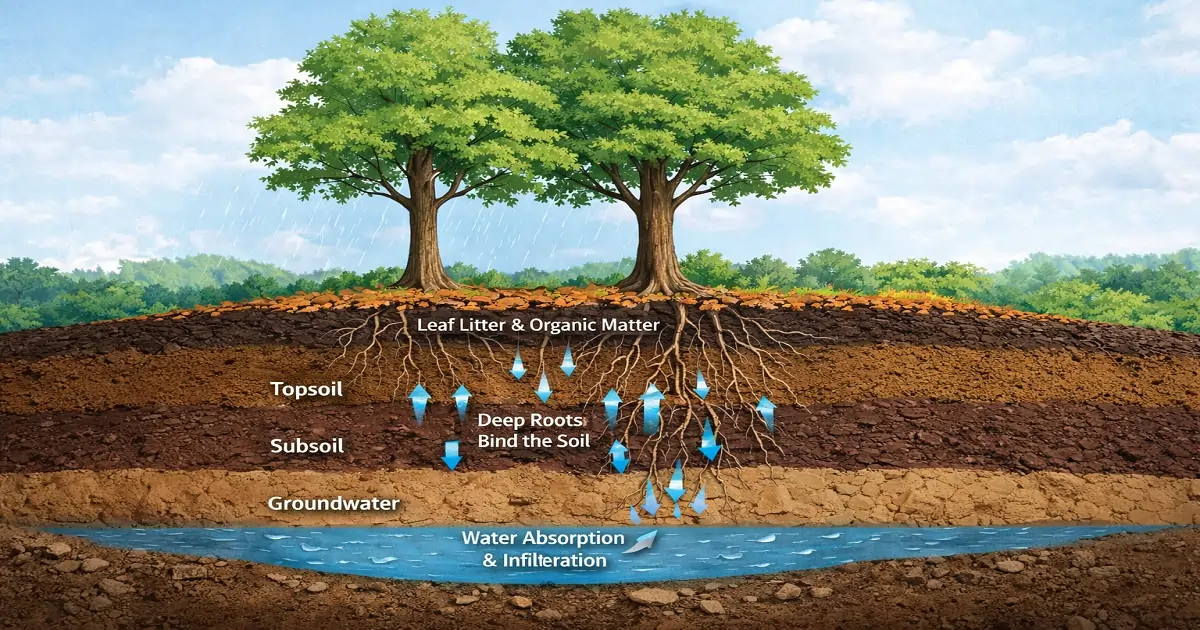
Forests prevent soil erosion through physical, biological, and hydrological processes. Each layer of a forest plays a specific role in protecting the land.
Tree Root Systems and Soil Stabilization
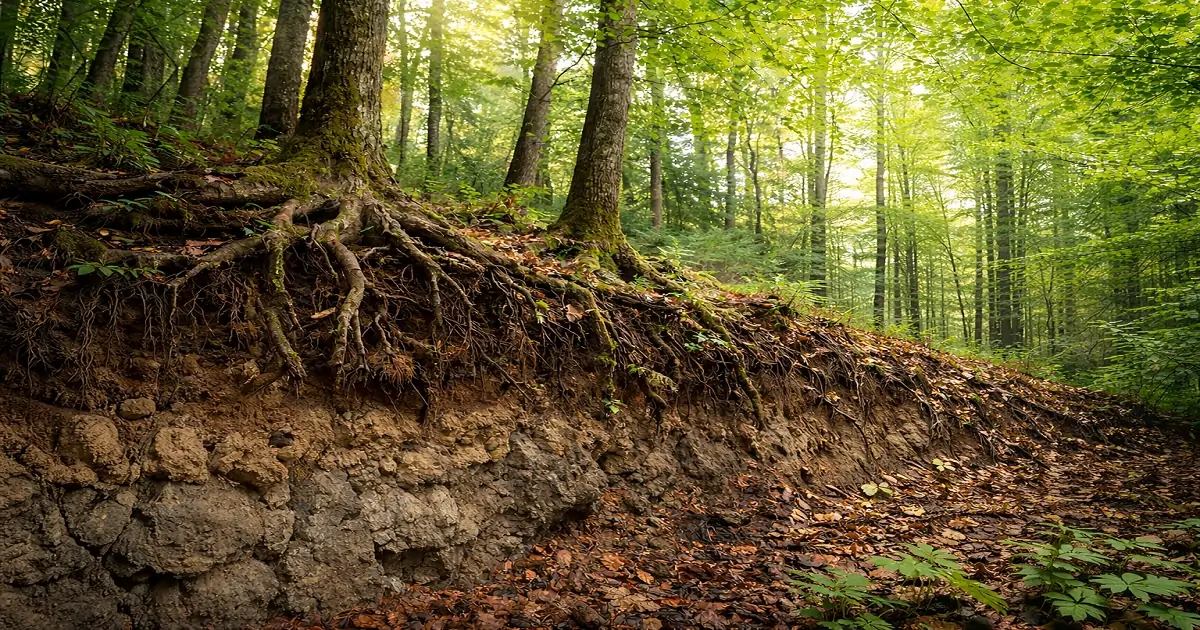
Tree roots spread deep and wide through the soil. These roots bind soil particles together. This makes the ground stronger and more stable.
On slopes, roots reduce the risk of landslides. They hold soil in place and resist gravity. Therefore, forested hillsides are less likely to collapse during storms.
Forest Canopy and Rainfall Interception
Forest canopies act like umbrellas. Leaves and branches catch rainfall before it reaches the ground. This reduces the force of falling rain.
Slower rain means less soil disturbance. Water reaches the soil gently, lowering surface runoff. As a result, less soil gets washed away.
You May Like: Overview of Forest and Wildlife Resources
Forest Floor Litter and Organic Matter
The forest floor is covered with fallen leaves, twigs, and plant remains. This layer protects soil from direct rain and wind.
Over time, this material breaks down into humus. Humus improves soil structure and helps soil hold water. Therefore, erosion risk drops further.
Improved Water Infiltration and Reduced Runoff
Forest soils absorb water more effectively. Roots and organic matter create spaces in the soil. Water moves downward instead of flowing across the surface.
This process reduces runoff and increases groundwater recharge. Consequently, soil stays in place and erosion slows down.
Facts and Evidence Supporting Forests and Soil Erosion Control
Real-world observations support the role of forests in soil erosion control. Across regions and climates, forested land consistently shows better soil stability.
Observations from Forested vs Deforested Landscapes
Forested areas usually have deeper, healthier soil. Erosion rates remain low even during heavy rainfall. In contrast, deforested land often shows exposed roots and gullies.
Crops grown on eroded land produce lower yields. Therefore, forest cover directly supports land productivity.
Evidence from Mountainous and Sloped Regions
Hilly regions face higher erosion risk due to gravity. Forests are especially important in these areas. Tree roots anchor soil and prevent slope failure.
Without forests, rain quickly washes soil downhill. With forests, slopes remain stable and erosion slows significantly.
Case Examples from Tropical and Temperate Forests
In tropical regions like the Amazon, intact forests protect fragile soils. Once trees are removed, erosion accelerates rapidly.
Temperate forests also show strong soil protection. Reforested watersheds often recover soil health within decades. These examples reinforce the protective role of forests.
Are Forest Areas Less Prone to Soil Erosion Than Open Land?
Forest areas are far less prone to soil erosion than open land. This difference becomes clear during storms and dry seasons.
Erosion can still occur in forests. However, its intensity remains much lower. The forest system slows every step of the erosion process.
Open land lacks this protection. Rain and wind directly strike the soil. Therefore, soil loss increases sharply.
Common Misconceptions About Forests and Erosion
Some believe erosion happens everywhere, so forests make little difference. This belief ignores scale and speed.
Erosion in forests is slow and manageable. Erosion on cleared land is fast and destructive. The difference matters greatly over time.
What Happens to Soil When Forests Are Removed?
Deforestation breaks the natural soil protection system. Once trees disappear, soil becomes exposed and fragile.
Immediate Effects of Deforestation on Soil
Root networks decay after trees are cut. Soil loses its binding structure. Canopy cover disappears, exposing soil to rain.
Organic layers thin out quickly. As a result, runoff increases and erosion begins almost immediately.
Long-Term Soil Degradation and Land Productivity Loss
Over time, nutrients wash away. Soil becomes compacted and less fertile. Water absorption declines further.
In severe cases, land turns barren. Desert-like conditions may develop. Restoring such land becomes difficult and costly.
The Role of Forest Conservation in Preventing Soil Erosion
Protecting forests is one of the most effective ways to control soil erosion. Conservation keeps natural systems intact and functioning.
Natural Forest Conservation
Preserving existing forests provides immediate benefits. Mature trees and stable soils already work together.
This approach costs less than repairing damaged land. Therefore, protection is more effective than restoration alone.
Reforestation and Afforestation Efforts
Planting trees helps restore degraded soil. Over time, roots rebuild soil structure and improve water absorption.
These efforts require patience. However, long-term gains include healthier soil and reduced erosion.
Global and Community-Based Conservation Efforts
Many regions support forest protection through local action. Communities manage forests for shared benefits.
These efforts improve soil health while supporting livelihoods. Therefore, conservation works best when people are involved.
Why Forests and Soil Erosion Control Matter for the Future
Soil protection supports food security. Healthy soil grows crops and supports farming communities.
Forests also strengthen climate resilience. Stable soil stores carbon and reduces flood risks. Furthermore, clean soil improves water quality.
Ecosystems depend on stable land. When soil remains intact, plants and animals thrive. Therefore, forests support life far beyond their boundaries.
Conclusion
Science, facts, and real-world evidence all point to one conclusion. Forests protect soil from erosion. Their roots, canopy, and organic layers work together to stabilize land.
Without forests, soil erosion accelerates and damages ecosystems. With forests, land remains productive and resilient. Protecting forests means protecting soil, water, and future generations.
Forest conservation is not optional. It is essential for a stable and sustainable planet.